Creative Profiles
Damien Hirst: The Artist Who Turned Shock Into a Global Brand
Tamara Edwards8 min read
From designer toys to city-block murals and campaigns for Nike, Hennessy, and Levi's, Eaton has turned street art into a fully realized creative business.

Arts & Business Contributor
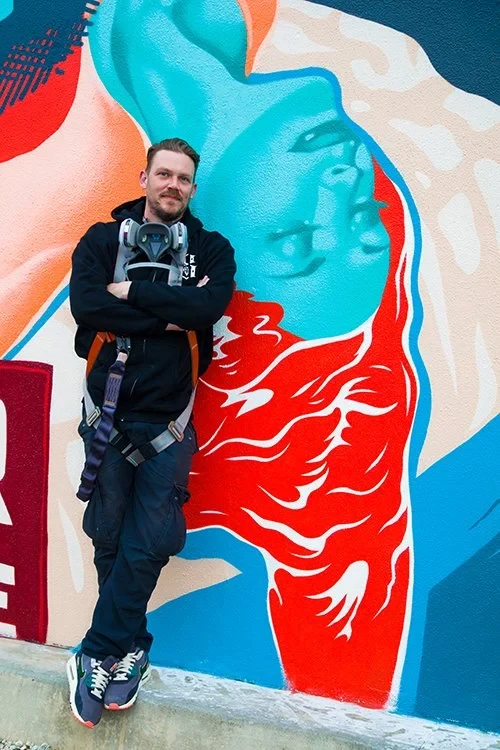
Tristan Eaton did not start on a wall. He started on a toy. In the early 2000s, Eaton was one of the defining figures of the designer toy movement, creating limited-edition collectibles that blurred the line between product design and fine art. That foundation, building objects that people wanted to own and display, turned out to be the perfect training ground for an artist who would go on to cover entire city blocks in paint.
"I want my work to feel like it belongs to the street, even when a brand is paying for it. The moment it feels like an ad, I've failed."
Born in Los Angeles and based in New York, Eaton developed a visual language that is immediately recognizable: layered compositions, bold graphic linework, and a palette that manages to feel both street-worn and meticulously crafted. His murals are not simply large paintings. They are dense, narrative works that reward close inspection, each layer revealing details that disappear from a distance.
His commercial career has been equally ambitious. Eaton has collaborated with some of the most recognizable brands in the world, including Levi's, Nike, Hennessy, and Absolut Vodka. These are not the kind of partnerships where a brand licenses an artist's existing work and slaps it on a product. Eaton builds campaigns from the ground up, working with creative teams to develop concepts that feel genuinely integrated rather than bolted on.
One of his most celebrated brand collaborations came with Hennessy, for whom he created a series of large-scale murals and limited-edition bottle designs that toured internationally. The project demonstrated what Eaton does better than almost anyone: translate a brand's identity into visual language that feels authentic to the street art world without losing the commercial clarity that makes it useful to a marketing team.
In New York, his murals have become landmarks. A massive portrait of Marilyn Monroe on the Lower East Side drew international attention and became one of the most photographed walls in the city. His work in Detroit, commissioned as part of the city's ongoing cultural revitalization, brought national press coverage and helped establish him as one of the artists most associated with the idea that public art can be a genuine economic and civic force.
Eaton has also been deliberate about building a business infrastructure around his practice. He runs a studio that handles everything from initial concept development to final installation, working with a team that allows him to take on projects at a scale that would be impossible for a solo artist. That operational discipline, rare in the street art world, has made him a reliable partner for brands and institutions that need to deliver on tight timelines and specific creative briefs.
What distinguishes Eaton from many of his peers is his fluency across contexts. He is equally comfortable in a gallery, on a building facade, in a boardroom, or in a product design meeting. That range has made him one of the most commercially successful muralists working today, and one of the clearest examples of how the skills developed in street art, speed, scale, adaptability, and an instinct for public impact, translate directly into business value.
About the author
Liz PlummerLiz Plummer is an executive producer, creative director, and arts contributor. She covers contemporary artists, design, architecture, creative entrepreneurship, and the cultural forces shaping modern business.